



Mono Ammonium Phosphate (MAP) 12-61-0: Benefits, Uses & Fertigation Guide
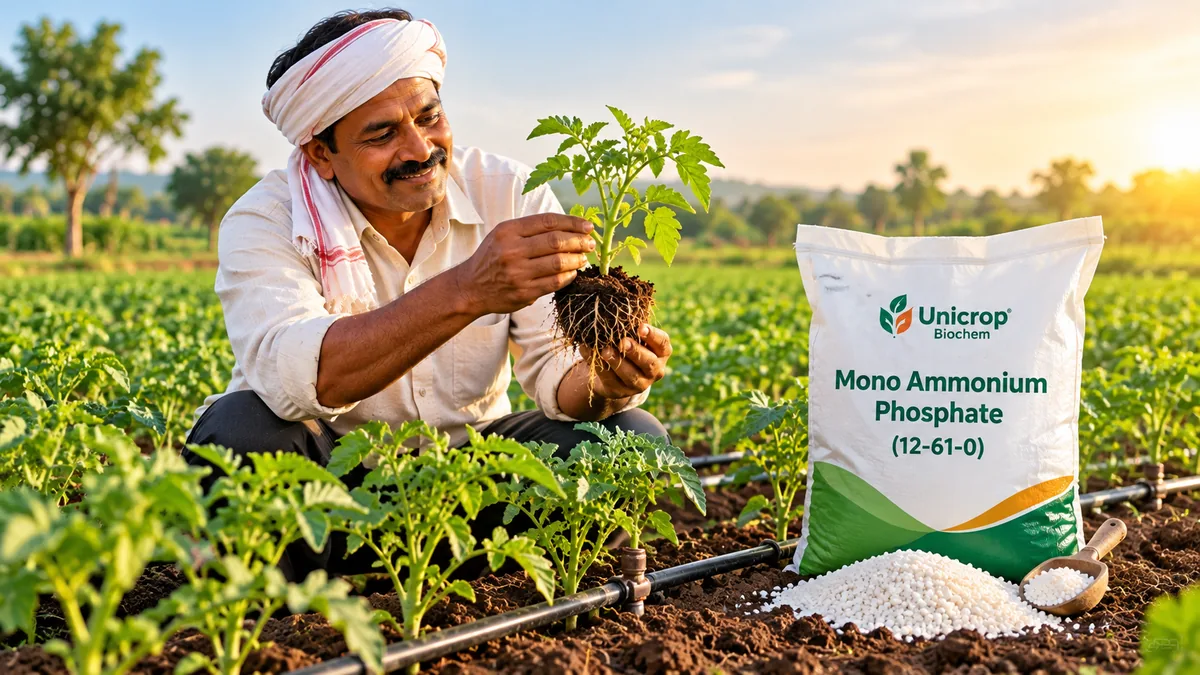
Mono ammonium phosphate fertilizer, commonly known as MAP 12-61-0, is a concentrated water-soluble source of phosphorus with a smaller amount of nitrogen. It is especially useful during crop establishment, active root development, transplant recovery and other growth stages where phosphorus demand is high.
Because MAP is highly soluble, it is commonly used in drip irrigation, fertigation and soluble fertilizer programs. Its nutrient profile makes it particularly useful when growers want to strengthen early crop development without adding potassium at the same time.
This guide explains how MAP fertilizer works, where it fits in crop nutrition, when it is most useful, how to apply it through fertigation and foliar programs, and which mixing precautions matter for safe, efficient use.
What Is Mono Ammonium Phosphate Fertilizer?
Mono ammonium phosphate is a water-soluble fertilizer that supplies nitrogen and phosphorus. A common agricultural grade is 12-61-0, which means the fertilizer contains 12% nitrogen and 61% phosphorus expressed as P2O5.
Unicrop Biochem lists Mono-Ammonium Phosphate (12-61-00) within its water-soluble fertilizer range. This type of formulation is useful in crop programs that need concentrated phosphorus together with a modest nitrogen contribution.
Why Phosphorus Is Important for Crop Growth
Phosphorus plays a major role in energy transfer, root development, flowering and overall crop establishment. A crop that receives adequate available phosphorus during its early stages is better positioned to build a strong root system and establish uniform growth.
Supports Root Development
Phosphorus is especially important when seedlings, transplants or newly germinated crops are building fresh roots. Adequate phosphorus supports root expansion and helps the plant explore more of the soil or growing medium.
Supports Energy Transfer
Phosphorus is involved in the plant's internal energy-transfer processes. These processes influence cell division, new tissue growth and other metabolic functions.
Supports Flowering and Reproductive Development
Phosphorus contributes to the development of flowers, seeds and fruiting structures. It is not a stand-alone flowering solution, but it remains an important part of balanced reproductive nutrition.
Why Nitrogen in MAP Also Matters
MAP also supplies ammonium nitrogen. This nitrogen contributes to early vegetative growth while the crop is establishing roots and leaves.
Because MAP already contains nitrogen, that nitrogen should be counted when calculating the complete fertilizer program. Applying MAP without considering other nitrogen sources can lead to unnecessary nitrogen input.
Key Benefits of MAP 12-61-0 Fertilizer
When used at the right stage and for the right crop requirement, MAP offers several practical advantages.
- Provides a highly concentrated source of phosphorus.
- Supplies nitrogen together with phosphorus.
- Supports early root development and crop establishment.
- Dissolves readily for drip irrigation and fertigation use.
- Can fit greenhouse, nursery, field and protected-cultivation programs.
- Can be used in nutrient-solution and soluble fertilizer programs.
- Allows growers to supply phosphorus without adding potassium.
When Is MAP Fertilizer Most Useful?
MAP is often most useful during stages where phosphorus demand is high and the crop is actively developing roots or recovering from transplant stress.
Common use stages include:
- Seedling establishment.
- Transplant recovery.
- Early vegetative growth.
- Active root development.
- Pre-flowering nutrition where phosphorus demand remains important.
- Fertigation programs requiring a concentrated phosphorus source.
The fertilizer should not automatically be used at the same rate throughout the entire crop cycle. As plants move into flowering, fruit filling and maturity, the nutrient ratio usually needs to change.
MAP Fertilizer for Drip Irrigation and Fertigation
One of the strongest uses of mono ammonium phosphate is fertigation. A fully water-soluble MAP fertilizer can be dissolved and injected through irrigation systems to deliver phosphorus and nitrogen directly into the active root zone.
Advantages in Fertigation
Fertigation allows nutrients to be applied in smaller, more controlled doses. This can help growers match fertilizer delivery more closely to crop stage and irrigation volume.
MAP is particularly useful where growers need phosphorus through the irrigation system without simultaneously increasing potassium.
Good Fertigation Practice
For reliable performance:
- Dissolve MAP completely before injection.
- Use clean irrigation water and appropriate filtration.
- Inject fertilizer after the system has reached normal operating pressure.
- Distribute nutrients evenly through the root zone.
- Flush the system with clean water where required.
- Monitor total EC and fertilizer concentration in intensive systems.
MAP Fertilizer for Vegetable Crops
Vegetable crops often have rapid early growth and high nutrient demand. MAP can be useful during nursery establishment, transplant recovery and early root development in crops such as tomato, chilli, cucumber, capsicum and other high-value vegetables.
In intensive vegetable systems, the MAP rate should be adjusted according to soil phosphorus status, fertigation frequency, crop stage and the total nutrient plan.
MAP Fertilizer for Fruit Crops
Fruit crops and orchards can benefit from phosphorus during root flushes, establishment and pre-flowering stages. MAP can be used where a soluble phosphorus source is needed through the irrigation system.
In established orchards, phosphorus application should be guided by soil tests, tissue analysis, irrigation water quality and previous crop response rather than routine use alone.
MAP Fertilizer for Nursery and Protected Cultivation
Nurseries, greenhouses and soilless systems require precise nutrient control. MAP is often useful because it is concentrated, soluble and easy to integrate into stage-specific fertilizer recipes.
However, total nutrient concentration should be monitored carefully. Young seedlings and sensitive root systems can be damaged by overly strong fertilizer solutions.
MAP Fertilizer vs. Mono Potassium Phosphate
MAP and mono potassium phosphate are both high-phosphorus water-soluble fertilizers, but they supply different companion nutrients.
| Fertilizer | Main Nutrients | Typical Use |
|---|---|---|
| MAP 12-61-0 | Nitrogen + phosphorus | Early growth, root development and phosphorus-rich fertigation |
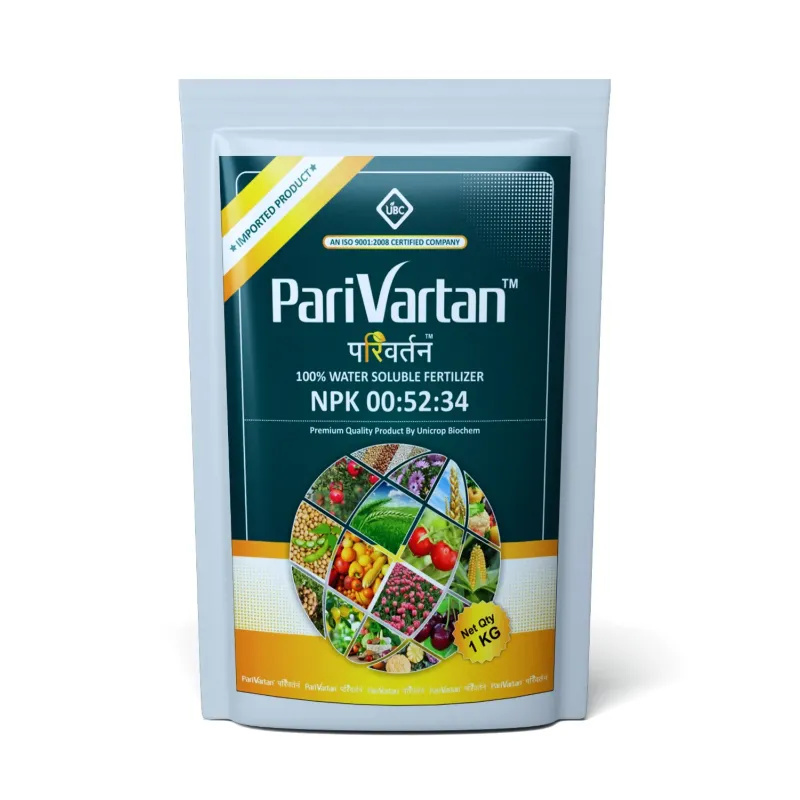
| MKP 0-52-34 | Phosphorus + potassium | Stages where phosphorus and potassium are needed without nitrogen |
Unicrop Biochem also offers Mono-Potassium Phosphate (0-52-34). The better choice depends on whether the crop needs nitrogen or potassium together with phosphorus.
MAP Fertilizer vs. Urea Phosphate
Both MAP and urea phosphate supply nitrogen and phosphorus, but their chemistry is different. Urea phosphate is generally more strongly acidic, while MAP is moderately acidic.
MAP can be a practical choice where growers want high phosphorus with ammonium nitrogen but do not require the stronger acidifying effect associated with urea phosphate.
Compatibility and Mixing Precautions
MAP should be handled carefully in concentrated fertilizer tanks. Phosphate fertilizers can react with calcium and magnesium sources and form insoluble precipitates.
To reduce the risk of blocked emitters or unavailable nutrients:
- Do not mix concentrated MAP directly with calcium fertilizers in the same stock tank.
- Use separate A and B tanks where required.
- Check compatibility before mixing with magnesium fertilizers.
- Perform a small jar test when combining unfamiliar products.
- Use clean water and suitable filtration.
Can MAP Be Used as a Foliar Fertilizer?
Suitable water-soluble MAP products can be used in foliar nutrition programs where the product label permits it. Foliar feeding can provide a supplemental route for phosphorus and nitrogen, particularly when a crop needs a quick nutrient response.
Foliar application should be treated as a supplement to a complete root-zone nutrition program. Use the specific product recommendation for concentration, crop stage and spray timing.
Common Mistakes to Avoid
MAP is effective when it solves a specific nutrient need. Avoid these common errors:
- Using high phosphorus without diagnosis: extra phosphorus does not always increase root growth or yield.
- Ignoring the nitrogen contribution: MAP already supplies nitrogen.
- Using the same rate all season: crop nutrient ratios change with growth stage.
- Mixing with calcium in one concentrated tank: this can cause precipitation.
- Applying overly strong solutions to seedlings: young roots are sensitive to high EC.
- Ignoring soil and tissue tests: fertilizer planning is stronger when based on actual crop conditions.
How to Get Better Results from MAP Fertilizer
A practical MAP program should be built around crop stage and phosphorus need.
- Check soil or growing-medium phosphorus status.
- Review the complete nitrogen and potassium program.
- Use MAP primarily when phosphorus demand is high.
- Choose fertigation, soil or foliar use according to product suitability.
- Keep concentrated MAP separate from incompatible calcium sources.
- Monitor EC in high-frequency fertigation systems.
- Adjust the fertilizer program as the crop moves into later reproductive stages.
Why Choose Unicrop Biochem Mono Ammonium Phosphate?
Unicrop Biochem offers Mono-Ammonium Phosphate (12-61-00) as part of its water-soluble fertilizer portfolio. It can be integrated into crop programs where a concentrated source of phosphorus and nitrogen is needed for establishment, root development or fertigation.
For product specifications, packaging, bulk availability and crop-specific guidance, contact Unicrop Biochem before finalizing a large-scale fertilizer program.
Frequently Asked Questions
1. What is MAP fertilizer used for?
MAP is mainly used to supply phosphorus and nitrogen, especially during early crop establishment, root development and phosphorus-demanding growth stages.
2. Is MAP 12-61-0 suitable for drip irrigation?
Yes. Water-soluble MAP is widely used in fertigation and drip irrigation when dissolved properly and managed with suitable filtration.
3. Can MAP be mixed with calcium nitrate?
Do not mix concentrated MAP and calcium nitrate in the same stock tank. Calcium and phosphate can form insoluble precipitates.
4. What is the difference between MAP and MKP?
MAP supplies nitrogen and phosphorus, while MKP supplies phosphorus and potassium. The best choice depends on the crop stage and nutrient requirement.
5. Is MAP suitable for early crop growth?
Yes. MAP is commonly used during establishment and early root development because it provides concentrated phosphorus together with nitrogen.
6. Can MAP be used as a foliar spray?
Suitable water-soluble MAP products can be used as foliar fertilizers when the product label allows it. Use the product-specific dilution and crop recommendation.
7. Should MAP be used throughout the crop cycle?
Not necessarily. MAP is often most useful during high-phosphorus-demand stages. Later stages may require a different balance of nitrogen, phosphorus and potassium.
Conclusion
Mono ammonium phosphate 12-61-0 is a practical water-soluble fertilizer for growers who need concentrated phosphorus together with nitrogen. Its strongest use is often during crop establishment, root development and fertigation programs where precise phosphorus delivery is important.
The best results come from stage-based nutrition, proper mixing practices and balanced fertilizer planning. MAP should be used according to actual crop demand rather than as a fixed fertilizer for every stage.
Need Mono Ammonium Phosphate for farm, dealer or bulk supply? Contact Unicrop Biochem for specifications, packaging, availability and technical guidance.