



Boron Fertilizer: Benefits, Uses & Application Guide
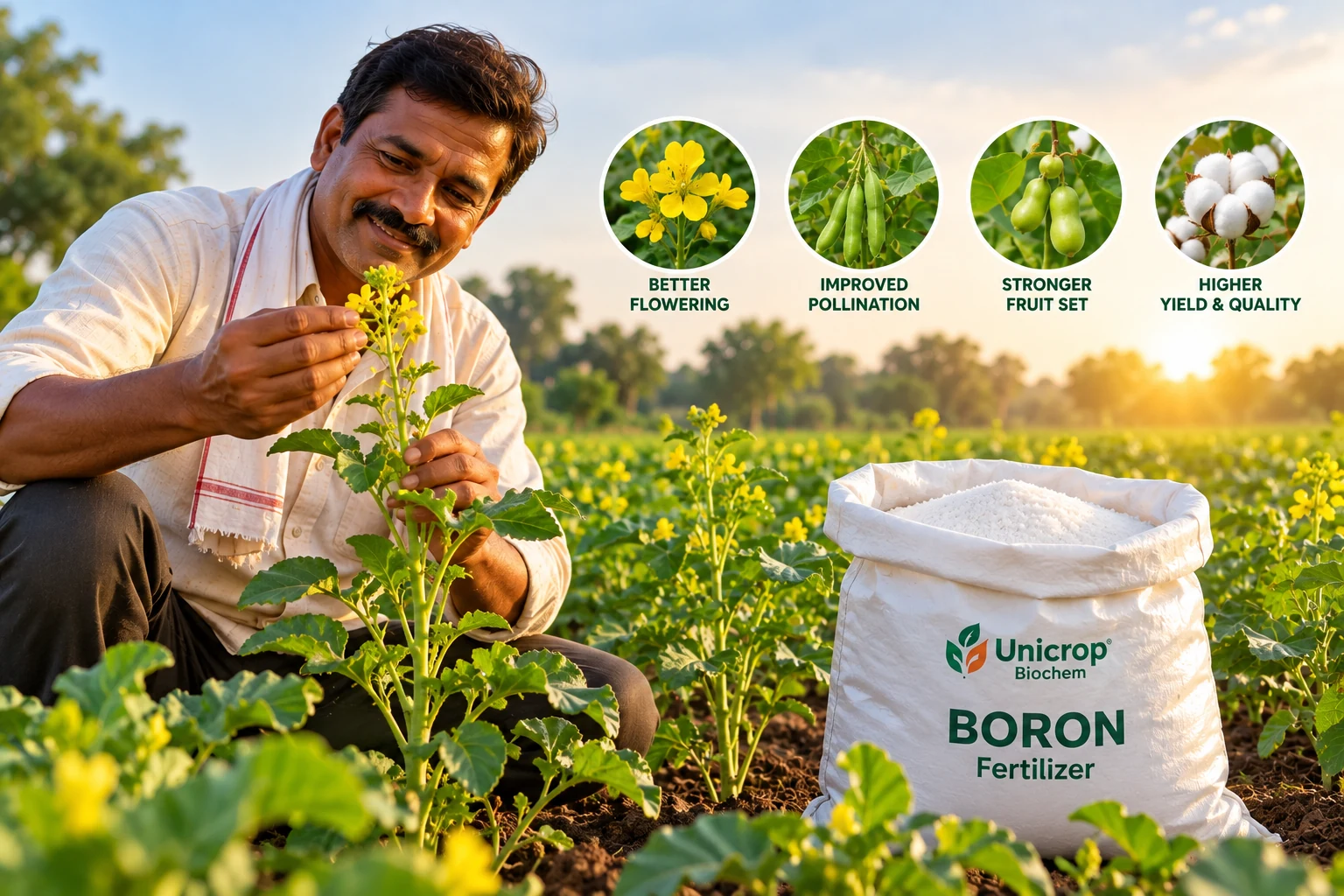
Boron fertilizer plays an important role in flowering, pollen activity, fruit set, cell-wall development and the movement of sugars within plants. Crops need boron only in small quantities, but a shortage during sensitive growth stages can affect reproductive development and overall crop performance.
Because the difference between deficiency and excess can be relatively narrow, boron should be used carefully. The best results come from matching the source, dose and timing to crop requirement, soil conditions and diagnostic information rather than applying it routinely at high rates.
This guide explains the role of boron in crop nutrition, common deficiency symptoms, key benefits, soil and foliar application options, practical precautions and where Unicrop Biochem's Boron 20% DOT can fit into a balanced micronutrient program.
What Is Boron Fertilizer?
Boron fertilizer is a micronutrient input used to supply boron when soil availability, crop demand or growing conditions are likely to create a deficiency. Agricultural boron products are available in different concentrations and formulations, so the guaranteed analysis on the product label should always be checked before selecting an application rate.
Boron is required in much smaller quantities than nitrogen, phosphorus or potassium, but it is still essential for normal plant development. It is especially important in rapidly growing tissues and reproductive structures.
Why Boron Is Important for Plants
Boron contributes to several plant processes that directly influence crop quality and reproductive performance.
Supports Flowering and Pollen Development
Boron is important for normal flower development and pollen function. When boron is inadequate during flowering, pollination and fertilization can be affected.
Supports Fruit and Seed Set
Because boron contributes to reproductive development, adequate nutrition can support better fruit or seed formation where deficiency is limiting performance.
Supports Cell-Wall Development
Boron contributes to the formation and stability of plant cell walls. This helps maintain normal development of new leaves, growing points, flowers and fruit tissues.
Supports Sugar Movement
Boron is involved in carbohydrate transport and metabolism. Efficient movement of sugars is important during active vegetative growth, flowering and fruit development.
Supports Root and Growing-Point Health
Young roots and shoot tips are particularly sensitive to boron shortage because boron is not freely redistributed from older tissues to new growth in many crops.
Common Boron Deficiency Symptoms
Boron deficiency symptoms often appear in young tissues and growing points. The exact symptoms vary by crop, but several patterns are common.
- Death or poor development of growing points.
- Distorted, thickened or brittle young leaves.
- Poor flowering or flower retention.
- Weak pollen activity and reduced fruit set.
- Cracking, corky tissue or internal disorders in some crops.
- Short, poorly developed roots.
- Uneven or malformed fruits where deficiency is severe.
These symptoms should not be diagnosed from appearance alone. Calcium problems, root stress, drought, disease and other micronutrient deficiencies can sometimes produce similar effects.
Why Boron Deficiency Happens
Boron availability is influenced strongly by soil, moisture and crop demand. A field can become boron deficient even when some boron is present in the soil.
Low Organic Matter
Soils with low organic matter may have less capacity to supply boron steadily during the crop cycle.
Light or Sandy Soils
Boron can be more easily leached from coarse-textured soils, particularly under high rainfall or heavy irrigation.
Dry Soil Conditions
Boron reaches roots mainly through soil water. Drought or irregular irrigation can reduce boron uptake even when soil reserves are not extremely low.
High Soil pH
Boron availability can become less predictable in alkaline conditions. Soil chemistry should therefore be considered when planning micronutrient applications.
High Crop Demand
High-yield crops, flowering vegetables, fruit crops and seed crops may have greater boron demand during reproductive stages.
Key Benefits of Boron Fertilizer
When boron is genuinely deficient, the right application can provide several crop-management benefits.
- Supports flower formation and pollen function.
- Supports fruit and seed set.
- Supports healthy growing points and root tips.
- Contributes to normal cell-wall development.
- Supports sugar transport within the plant.
- Can help correct diagnosed boron deficiency.
- Complements a balanced macro- and micronutrient program.
How to Apply Boron Fertilizer
The correct application method depends on crop type, product concentration, soil test results, deficiency severity and the production system. Because boron is required in small amounts, product-specific guidance is especially important.
Soil Application
Soil application can be useful when the objective is to improve boron availability in the root zone over a longer period. Uniform distribution is important because concentrated pockets of boron can increase the risk of over-application.
Where boron is applied with other fertilizers, the mixture should be blended thoroughly and used according to the product recommendation.
Foliar Application
Foliar boron can be useful when a standing crop needs a targeted correction or when growers want to support a sensitive reproductive stage such as pre-flowering or flowering.
Use only the dilution recommended for the specific product and crop. Excessive foliar concentration can cause leaf damage, especially under hot or dry conditions.
Fertigation
Some boron formulations are suitable for fertigation when fully soluble and compatible with the irrigation system. Concentrated stock solutions should be prepared carefully, and water quality and fertilizer compatibility should be checked before mixing.
Boron Fertilizer for Flowering Crops
Flowering crops are particularly sensitive to boron status because reproductive tissues have a strong requirement during pollen formation and fertilization.
In vegetables, oilseeds, pulses and fruit crops, boron management should begin before serious flowering problems become visible. Soil history, tissue analysis and previous crop response can help determine whether a boron application is justified.
Boron Fertilizer for Fruit Crops
Fruit crops depend on successful flowering, pollination and early fruit development. A boron shortage during these stages can affect fruit set and uniformity.
For orchards and vineyards, growers should consider both the current crop stage and long-term soil conditions. Repeated foliar correction without addressing an underlying soil or moisture problem may only provide a temporary solution.
Boron Fertilizer for Vegetables
Vegetable crops with rapid growth and heavy flowering can show boron deficiency when soil supply does not keep pace with demand. Symptoms may include distorted young leaves, weak growing points, poor flowering and uneven fruit set.
Because vegetables are often intensively fertilized, boron should be balanced with calcium, nitrogen, potassium and other nutrients rather than managed in isolation.
Boron Fertilizer for Oilseeds and Pulses
Oilseed and pulse crops can be sensitive to boron during flowering and seed formation. Where soils are known to be boron deficient, correcting the shortage can support reproductive development.
Application decisions should still be based on local agronomic guidance, product concentration and field history because crop sensitivity differs between species.
Boron and Calcium: Why Balance Matters
Boron and calcium both contribute to developing tissues and cell-wall function. A crop showing cracking, poor fruit quality or weak growing points may have a problem involving one or both nutrients, but the correct solution depends on diagnosis.
Simply adding boron will not correct poor calcium uptake caused by irregular irrigation, root damage or salinity. Likewise, adding calcium will not replace boron where the crop is genuinely deficient.
Boron Fertilizer vs. Other Micronutrients
Boron should not be treated as a general-purpose substitute for other micronutrients. Zinc, iron, manganese, copper and molybdenum each perform different functions within the plant.
| Micronutrient | Main Role | Typical Deficiency Concern |
|---|---|---|
| Boron | Flowering, cell walls, fruit and seed set | Growing-point damage, poor reproductive development |
| Zinc | Enzyme activity and growth regulation | Small leaves, short internodes, chlorosis |
| Iron | Chlorophyll formation and electron transfer | Young-leaf chlorosis |
| Manganese | Photosynthesis and enzyme activity | Interveinal chlorosis and reduced vigor |
A complete micronutrient plan should therefore be based on the crop's actual requirement rather than applying several nutrients together without diagnosis.
Compatibility and Mixing Precautions
Before combining boron fertilizer with other crop inputs, check the product instructions and compatibility. Concentrated fertilizer mixtures can react differently depending on water quality, pH and the other nutrients present.
When compatibility is uncertain, a small jar test is useful before preparing a full tank. In foliar programs, pesticide and fertilizer combinations should also be checked carefully to avoid crop injury.
Common Mistakes to Avoid
Boron is essential, but it is also a nutrient where unnecessary over-application can create problems. Avoid these common mistakes:
- Applying boron without confirming need: visible symptoms may have another cause.
- Using a high dose because boron is deficient: boron is required only in small quantities.
- Applying unevenly: concentrated patches can increase toxicity risk.
- Ignoring soil moisture: dry soil can reduce boron uptake.
- Using one dose for every product: boron concentration varies between formulations.
- Mixing products without checking compatibility: tank mixtures can create instability or crop injury.
How to Get Better Results from Boron Fertilization
A good boron program is precise and stage-specific.
- Review soil type, pH and organic matter.
- Look at crop symptoms and previous field response.
- Use soil or tissue testing where possible.
- Identify the most sensitive crop stage, especially flowering and fruit set.
- Select a product concentration that fits the application method.
- Follow the product-specific dose carefully.
- Maintain consistent irrigation so roots can access nutrients.
- Monitor new growth and reproductive performance after application.
Why Choose Unicrop Biochem Boron 20% DOT?
Unicrop Biochem offers Boron 20% DOT as part of its micronutrient and crop-nutrition portfolio. It can be considered in programs where boron supplementation is required and where the application method matches the product specification.
For product specifications, packaging, bulk availability and crop-specific application guidance, contact Unicrop Biochem before finalizing a large-scale boron program.
Frequently Asked Questions
1. What is boron fertilizer used for?
Boron fertilizer is used to supply boron for flowering, pollen function, fruit and seed set, cell-wall development and healthy growing points.
2. What are common boron deficiency symptoms?
Symptoms can include damaged growing points, distorted young leaves, poor flowering, weak fruit set, cracking or malformed tissues and short roots.
3. Can boron fertilizer be sprayed on leaves?
Suitable formulations can be applied as foliar sprays. The product-specific dilution should always be followed because boron has a relatively narrow margin between deficiency and excess.
4. Can boron fertilizer be applied to soil?
Yes. Soil application can be useful where the root zone has low available boron and a more sustained correction is needed.
5. When is the best time to apply boron?
Timing depends on the crop, but boron is often especially important before flowering, during flowering and during early reproductive development.
6. Can too much boron harm plants?
Yes. Excess boron can damage crops. That is why product concentration, application rate and uniform distribution must be managed carefully.
7. Should boron be applied every season?
Not automatically. Application should be based on soil conditions, crop demand, diagnostic information and previous field response.
Conclusion
Boron fertilizer can be an important part of crop nutrition when boron is genuinely limiting. Its strongest roles are linked to flowering, pollen activity, fruit and seed set, growing-point health and cell-wall development.
The key is precision. Boron should be applied at the correct crop stage and at the correct product-specific rate, with attention to soil moisture, pH and the overall nutrient program.
Need Boron 20% DOT for farm, dealer or bulk supply? Contact Unicrop Biochem for specifications, packaging, availability and technical guidance.